Six Chinese AI models carry Blackwell fingerprints
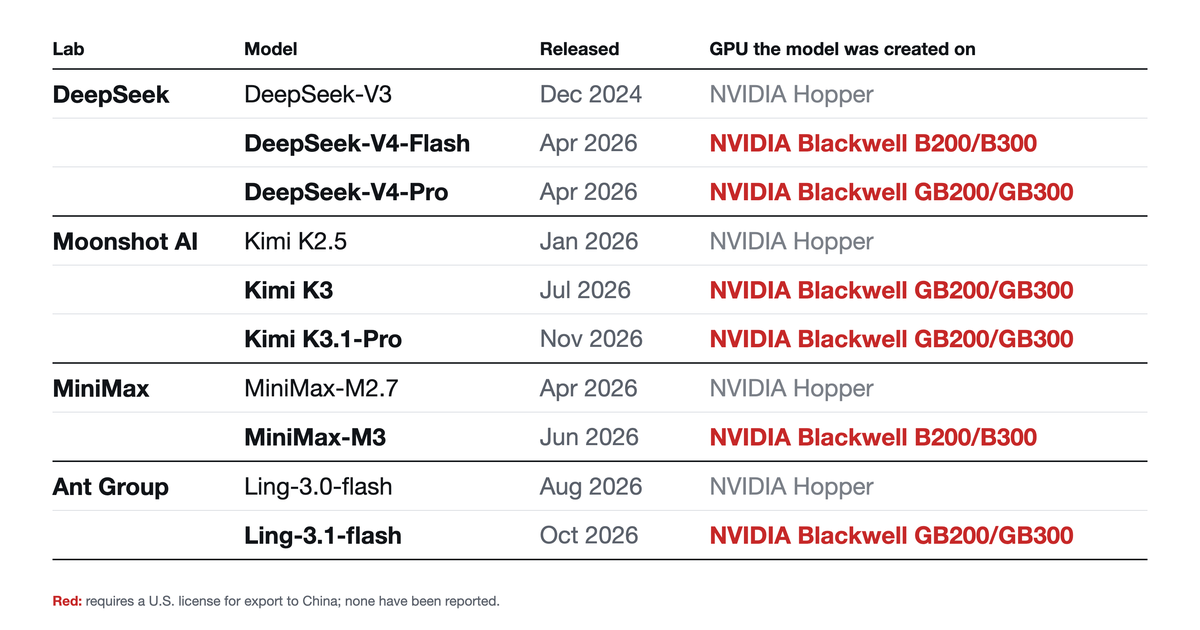
A forensic study of open weights says six models from DeepSeek, Moonshot, MiniMax and Ant Group were started on export-controlled Blackwell chips.
What it means for founders
If you ship products on DeepSeek or Kimi weights, nothing here changes the licence you use them under. It does give lawmakers technical evidence at the moment Congress is weighing tighter chip rules after Jensen Huang's exit. Keep an alternative model tested in case policy reaches model access.
If you publish open weights, this is the bigger lesson. If PyTorch set your starting weights on a GPU, the released weights can reveal which class of chip did it, years later. The report notes that starting weights generated on a CPU leave no such trace, so teams with a reason to keep their hardware private now have a known leak to plan around.
The report does not include responses from the four labs or Nvidia. Watch for them, and for independent researchers rerunning the method on the published weights.
What we don't know yet
The report says its evidence shows access to the chips, not where they were or how they were obtained, and does not establish an export violation. Blackwell systems can be rented outside China. The fingerprint shows the hardware that created the starting weights, which supports but does not prove that the same chips did the training. A specially configured AMD MI300X, also export-controlled, can produce the same pattern; the report ruled that out only for DeepSeek-V4-Flash and calls it very unlikely for the rest. The report also says it is not confident in its estimate of roughly 12,000 Blackwell chips across five runs, and it raised its estimates on the day of publication.
The story
Six open-weight models from four Chinese labs contain numerical patterns that match Nvidia's Blackwell chips, which need a US licence for export to China (the report says none have been reported), according to a forensic report from Unemployment Labs published on November 12. TechCrunch reports that the nonprofit is led by former OpenAI researcher Will DePue.
The models are DeepSeek's V4-Flash and V4-Pro, Moonshot AI's K3 and K3.1-Pro, MiniMax's M3 and Ant Group's Ling-3.1-flash, all out since April 2026. The same labs' earlier releases, including DeepSeek-V3 and Kimi K2.5, read as the previous Hopper generation.
How the fingerprint works
Before training, a model's weights get random starting values. In PyTorch on Nvidia chips, those values come from a seeded generator split across thousands of GPU threads, and the thread count depends on how many processor cores the chip has: 132 on Hopper, 148 on the B200 and B300, 152 on the GB200 and GB300. The same seed lands its numbers in different positions on different chips. Some weights, such as those for tokens never seen in training, keep their starting values, so the report works backward to the seed and core count.
The team checked the method on real hardware. A Blackwell B300 regenerated 445 rows of the untouched weights in DeepSeek-V4-Flash exactly, while an H100 reproduced DeepSeek-V3 and not V4-Flash. It also agreed with all 24 models whose makers had disclosed their hardware, which the report calls a consistency check rather than an accuracy rate. The report calls the DeepSeek-V4-Flash evidence conclusive and the rest strong.
Not every lab has switched, by the report's reading. The newest models it could read from Alibaba, Zhipu, Tencent, Xiaomi and StepFun read as Hopper, though it says that does not rule out later training on Blackwell.
Sources
Tools in this story
We may earn a commission if you sign up through our links. It never affects our ratings or which stories we cover.
A free chatbot on open-weight frontier models
Moonshot's AI assistant for agents, code and research
More in Research
- Physicist says Astra led his Standard Model proofA physicist says OpenAI's GPT-6 Astra took the lead on the detailed proof behind a candidate lattice definition of the Standard Model.OpenAI · 2d ago

- Podqi finds chatbots sending shoppers to risky sitesA Podqi study found Perplexity, ChatGPT and Gemini showed risky or fake retail sites in 4% to 15% of shopping answers.The Verge · 6d ago

- DeepMind launches AlphaGenome 2 DNA model via API
For founders: A startup cannot use the AlphaGenome Services for company work. The AlphaGenome terms open them only to individuals, non-commercial organizations and…
Google DeepMind · 7d ago - AlphaProof Code verifies Signal's libsignal in Lean
For founders: Specifications are now the expensive part. A team of five finished in four weeks without writing proof code themselves.
Google DeepMind · 8d ago - OpenAI claims AI proofs on Kakeya, ETH and QCD

For founders: Watch the ETH review closely. If it holds, problems long assumed hard under ETH may admit faster exact algorithms, though OpenAI itself says practical gains…
OpenAI · 23d ago

